Before the structured world of the International Union of Pure and Applied Chemistry (IUPAC), organic chemistry felt a bit like the Wild West of nomenclature. Chemists in different regions might call the same molecule by completely different names, leading to a tangled mess of miscommunication and scientific confusion. Imagine discussing a groundbreaking discovery only to realize you’re talking about two entirely different compounds!
Thankfully, IUPAC stepped in, establishing a universal language for chemical nomenclature. Understanding IUPAC Naming Principles isn't just an academic exercise; it's fundamental to confidently discussing, analyzing, and describing organic chemical structures. It ensures that when you write "ethanol," a chemist in Tokyo, Texas, or Timbuktu understands precisely the molecule you mean. This guide will walk you through these principles, transforming complex structures into clearly identifiable names you can master.
At a Glance: Your Roadmap to Organic Naming Mastery
- IUPAC is the universal standard: It eliminates ambiguity in chemical communication worldwide.
- The parent chain is key: Always find the longest continuous carbon chain first.
- Numbering ensures unique addresses: Assign numbers to carbons to provide the lowest possible locants for substituents and functional groups.
- Functional groups dictate identity: These are the most important parts of a molecule, determining its primary suffix and reactivity.
- Substituents are the side details: Groups attached to the main chain are named as prefixes and alphabetized.
- Practice makes perfect: Consistent application of rules builds confidence and accuracy.
Why IUPAC Matters: Bringing Order to the Chemical Cosmos
In the early days of chemistry, compounds were often named based on their origin (like formic acid from ants, formica in Latin) or a defining property. As the number of known organic compounds exploded – literally millions exist today – this haphazard approach became unsustainable. A single compound might have half a dozen "common" names, making scientific discourse a minefield.
IUPAC nomenclature provides a systematic, unambiguous method. It's a precise set of rules that allows you to construct a unique name for every organic compound and, crucially, to draw the exact structure from any given IUPAC name. This global standardization is the bedrock of modern chemistry, ensuring that research can be shared, replicated, and built upon without linguistic barriers or structural misunderstandings. It's the lingua franca of organic chemistry, and knowing it empowers you to speak with authority and clarity.
The Fundamental Framework: Six Steps to Naming Success
At its core, naming an organic compound is like solving a puzzle with a fixed set of rules. You're identifying the main structure, the additions, and their precise locations. Let's break down the systematic approach:
Step 1: Unearthing the Parent Chain – The Backbone of Your Molecule
The first, and often most critical, step is to find the longest continuous chain of carbon atoms in the molecule. This chain forms the "backbone" of your compound and dictates its base name. Think of it as identifying the main road before you label the houses along it.
- Root Names by Carbon Count:
- 1 Carbon: Meth- (e.g., methane)
- 2 Carbons: Eth- (e.g., ethane)
- 3 Carbons: Prop- (e.g., propane)
- 4 Carbons: But- (e.g., butane)
- 5 Carbons: Pent- (e.g., pentane)
- 6 Carbons: Hex- (e.g., hexane)
- 7 Carbons: Hept- (e.g., heptane)
- 8 Carbons: Oct- (e.g., octane)
- 9 Carbons: Non- (e.g., nonane)
- 10 Carbons: Dec- (e.g., decane)
For example, a molecule with a continuous chain of five carbons will have "pent-" as its root. Even if there are branches, you must ensure the chain you pick is the absolute longest.
Step 2: Numbering the Chain – Giving Every Carbon Its Address
Once you've identified the parent chain, you need to number its carbon atoms. This isn't arbitrary; there's a specific logic: you number from the end that gives the lowest possible set of numbers (locants) to the first substituent or functional group you encounter.
Imagine two ends of a street. You want to start numbering the houses from the end where the first house with a unique feature (like a garden or a specific color) appears soonest. This ensures everyone arrives at the same address for the same house. If there's a tie for the first point of difference, you continue numbering to give the lowest numbers to all subsequent groups.
Step 3: Identifying Substituents – The Molecule's Decorations
Substituents are the atoms or groups of atoms that are attached to the parent chain, but aren't part of the chain itself. These are your side groups, branches, or "decorations." Common examples include:
- Methyl (-CH₃)
- Ethyl (-C₂H₅)
- Propyl (-C₃H₇)
- Chloro (Cl)
- Bromo (Br)
- Iodo (I)
- Fluoro (F)
When you identify a substituent, you also note its position on the parent chain using the number (locant) assigned in Step 2. If there are multiple identical substituents (e.g., two methyl groups), you use prefixes like di- (for two), tri- (for three), tetra- (for four), etc., before the substituent name.
Crucially, when listing multiple different substituents in the final name, they are alphabetized. The prefixes di-, tri-, tetra- are ignored for alphabetization purposes (e.g., ethyl comes before dimethyl).
Step 4: Recognizing Functional Groups – The Heart of Reactivity
Functional groups are specific groups of atoms within a molecule that are responsible for its characteristic chemical reactions. They are the most important part of a molecule because they largely dictate its behavior. Think of them as the engine of a car—it's what makes it go.
Examples include hydroxyl groups (-OH, defining alcohols), carbonyl groups (>C=O, found in aldehydes and ketones), and carboxyl groups (-COOH, defining carboxylic acids). Identifying the highest priority functional group is paramount, as it determines the compound's primary class and its suffix.
Step 5: Choosing the Right Suffix or Prefix – The Naming Hierarchy
Not all functional groups are created equal in the eyes of IUPAC. There's a strict hierarchy that dictates which group gets the prestigious "suffix" position (the main identifier at the end of the name) and which are relegated to "prefix" status.
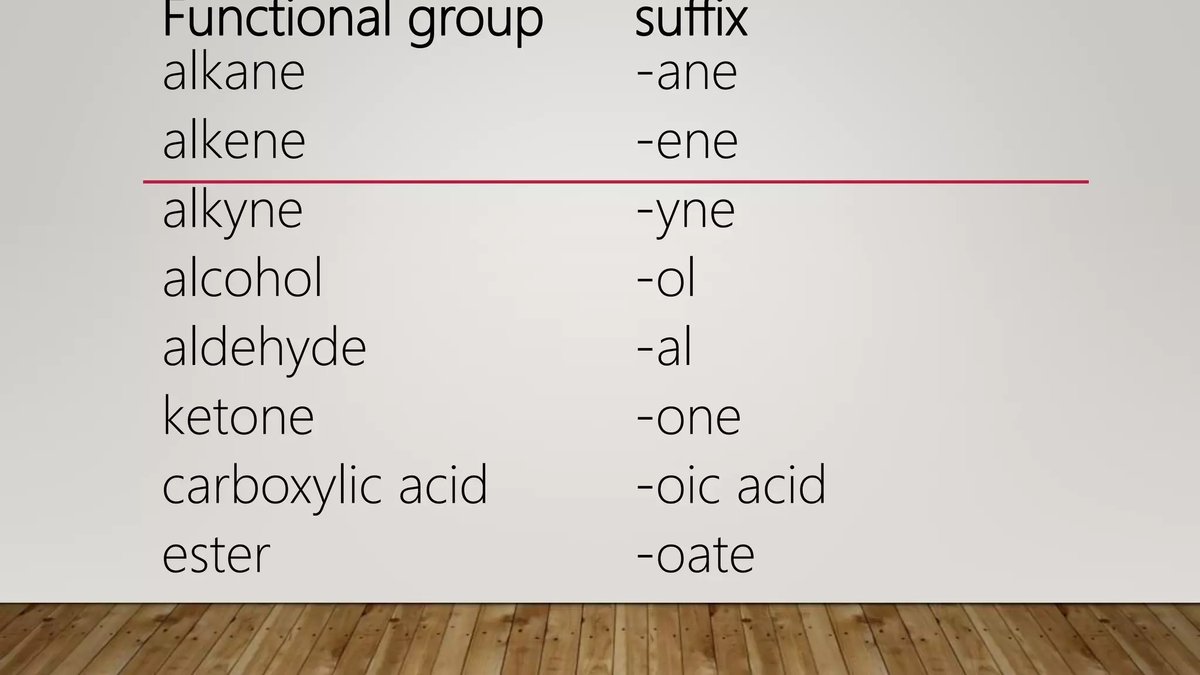
Functional Group Priority Order (Highest to Lowest):
- Carboxylic acids (-COOH): Suffix
-oic acid - Esters (-COOR): Suffix
-oate(as alkyl alkanoate) - Acid Halides (-COX): Suffix
-oyl halide - Amides (-CONH₂): Suffix
-amide - Nitriles (-C≡N): Suffix
-nitrile - Aldehydes (-CHO): Suffix
-al(always C-1) - Ketones (>C=O): Suffix
-one - Alcohols (-OH): Suffix
-ol - Phenols (-OH on benzene): Suffix
-ol(or phenol as base name) - Amines (-NH₂): Suffix
-amine - Alkenes (C=C): Suffix
-ene - Alkynes (C≡C): Suffix
-yne - Ethers (R-O-R'): Prefix
alkoxy- - Halides (Cl, Br, F, I): Prefix
halo-(chloro-, bromo-, etc.) - Alkanes (C-C single bonds): Suffix
-ane
The functional group with the highest priority determines the primary suffix of the compound. All other functional groups present in the molecule are then treated as prefixes. For instance, if a molecule contains both an alcohol (-OH) and a ketone (>C=O) group, the ketone will take precedence and determine the-onesuffix, while the alcohol will be named as a "hydroxy-" prefix.
Step 6: Assembling the Full Name – The Grand Synthesis
With all the pieces identified, numbered, and prioritized, it's time to put them together. The general format for an IUPAC name is:
Locant(s)-Substituent(s)-Parent Chain Root-Suffix(es)
Let's use an example from our ground truth: 2-methylpropan-2-ol
- Prop-: Indicates a three-carbon parent chain.
- -an-: Indicates single C-C bonds in the parent chain.
- -2-ol: Indicates a hydroxyl (alcohol) group on the second carbon.
- 2-methyl: Indicates a methyl group on the second carbon.
The name precisely describes the molecule: a three-carbon chain, saturated, with a hydroxyl group and a methyl group both attached to the middle (second) carbon.
Beyond the Basics: Classifying Organic Compounds Through Their Names
IUPAC naming isn't just about identifying a single compound; it also provides a framework for understanding broad classes of organic molecules. Compounds are classified based on key structural features:
By Functional Groups: The Defining Characteristics
The functional groups are so central that they form the primary basis for classifying organic compounds:
- Alkanes: Contain only carbon-carbon single bonds. Suffix:
-ane. (e.g., Methane, Hexane) - Alkenes: Contain at least one carbon-carbon double bond. Suffix:
-ene. (e.g., Ethene, But-2-ene) - Alkynes: Contain at least one carbon-carbon triple bond. Suffix:
-yne. (e.g., Ethyne, Propyne) - Alcohols: Contain a hydroxyl (-OH) group attached to an alkyl carbon. Suffix:
-ol. (e.g., Ethanol, Propan-2-ol) - Phenols: Contain a hydroxyl (-OH) group directly attached to a benzene ring. Suffix:
-ol(often named as derivatives of phenol). - Ethers: Contain an oxygen atom bonded to two alkyl or aryl groups (R-O-R'). Named as
alkoxyalkane. (e.g., Methoxyethane) - Aldehydes: Contain a carbonyl group (C=O) where the carbon is bonded to at least one hydrogen and one alkyl/aryl group (R-CHO). Suffix:
-al. (e.g., Ethanal, Propanal) - Ketones: Contain a carbonyl group (C=O) where the carbon is bonded to two alkyl or aryl groups (R-CO-R'). Suffix:
-one. (e.g., Propanone, Butan-2-one) - Carboxylic Acids: Contain a carboxyl group (-COOH). Suffix:
-oic acid. (e.g., Ethanoic acid, Propanoic acid) - Esters: Derivatives of carboxylic acids where the -H of -COOH is replaced by an alkyl/aryl group (R-COOR'). Named as
alkyl alkanoate. (e.g., Methyl ethanoate) - Amines: Derivatives of ammonia (NH₃) where one or more hydrogens are replaced by alkyl/aryl groups (-NH₂, -NHR, -NR₂). Suffix:
-amine. (e.g., Methylamine, Dimethylamine) - Amides: Contain a carbonyl group bonded to a nitrogen atom (-CONH₂). Suffix:
-amide. (e.g., Ethanamide) - Nitriles: Contain a cyano group (-C≡N). Suffix:
-nitrile. (e.g., Ethanenitrile)
By Chain Structure: The Molecular Architecture
The overall shape and connectivity of the carbon atoms also characterize compounds:
- Straight-chain: Carbons are connected in a linear, unbranched fashion.
- Branched-chain: Contains one or more alkyl groups extending from the main chain.
- Cyclic: Carbon atoms form a closed ring structure, like cycloalkanes (e.g., Cyclohexane).
- Aromatic: Contains a special type of cyclic, planar ring system with delocalized pi electrons, typically exemplified by the benzene ring.
- Heterocyclic: Cyclic compounds where at least one atom in the ring is not carbon (e.g., nitrogen, oxygen, sulfur).
By Saturation: The Presence of Multiple Bonds
This classification describes the type of bonds between carbon atoms:
- Saturated: Contains only carbon-carbon single bonds (e.g., alkanes). These compounds are "saturated" with hydrogen atoms.
- Unsaturated: Contains at least one carbon-carbon double or triple bond (e.g., alkenes, alkynes). They have fewer hydrogen atoms than their saturated counterparts.
- Aromatic: A special category of unsaturated compounds with highly stable, delocalized pi electron systems.
Tackling Complexity: Naming More Intricate Structures
While the basic six steps form the foundation, some compounds present unique structural challenges that require additional rules.
Cyclic Compounds: Rings and Rounds of Naming
When carbon atoms form a ring, the "cyclo-" prefix is added to the parent alkane name. For example, a six-carbon ring is cyclohexane.
- Numbering Cyclic Rings: The ring carbons are numbered to give the lowest possible locants to substituents or functional groups. If there's a functional group on the ring, it gets priority (e.g., in cyclohexanol, the carbon bearing the -OH group is C-1). If only substituents are present, they are numbered to achieve the lowest sum of locants, alphabetizing when there's a tie. For instance, 1-ethyl-2-methylcyclohexane.
Aromatic Compounds: The Benzene Bunch
Benzene (C₆H₆) is the quintessential aromatic compound. Its unique stability and structure lead to specific naming conventions:
- Benzene as Parent: When benzene is the primary structure, substituents are numbered around the ring (e.g., 1,2-dimethylbenzene).
- Special Prefixes for Disubstituted Benzenes: For two substituents on a benzene ring, you can use:
- ortho- (o-): Substituents on adjacent carbons (1,2-position).
- meta- (m-): Substituents separated by one carbon (1,3-position).
- para- (p-): Substituents on opposite carbons (1,4-position).
- Phenyl Group: When a benzene ring is attached to a longer chain or a higher-priority functional group, the benzene ring acts as a substituent and is named "phenyl." For example, 2-phenylpropane.
Polyfunctional Molecules: When Multiple Groups Compete
This is where the functional group priority list becomes indispensable. In molecules with more than one functional group, the highest priority group dictates the compound's suffix. All other functional groups, regardless of their complexity, are treated as prefixes.
Consider HO-CH₂-CH₂-COOH. This molecule has both an alcohol (-OH) and a carboxylic acid (-COOH) group. According to the priority list, carboxylic acids are higher than alcohols.
- The parent chain is a three-carbon chain (
prop-). - The carboxylic acid group makes it a
-oic acid. - The alcohol group becomes a "hydroxy-" prefix.
- The carboxylic acid carbon is automatically C-1. So the alcohol is on C-3.
Therefore, the name is 3-hydroxypropanoic acid. It's a systematic way to manage multiple active sites within a single molecule. When you're dealing with complex multi-functional molecules and need to double-check your work or explore possibilities, remember that an accurate IUPAC name generator can be an invaluable tool to confirm your nomenclature.
Mastering the Art: Practical Tips for Flawless Naming
Understanding the rules is one thing; applying them confidently is another. Here are some practical tips to hone your IUPAC naming skills:
- Always Begin with the Longest Parent Chain: This cannot be stressed enough. Many errors stem from misidentifying the parent chain, especially in branched structures. Don't just look for a straight line; trace all possible continuous carbon paths.
- Number from the Closest Significant Group: Whether it's the first substituent or, more critically, the highest priority functional group, ensure your numbering provides the lowest possible set of locants.
- Draw the Structure! Before you even attempt to name, draw out the full structural formula. It makes identifying chains, functional groups, and substituents far clearer than working from a condensed formula.
- Use Your Priority List Religiously: For polyfunctional compounds, the priority order is your map. Don't guess which group is more important; consult the list.
- Break Down Complex Structures: If a molecule looks overwhelming, mentally (or physically, with a pencil) break it into its components: parent chain, functional groups, and substituents. Name each part, then assemble.
- Practice, Practice, Practice: Like learning any new language, fluency in IUPAC nomenclature comes from consistent practice. Work through examples, draw structures from names, and name structures from drawings.
- Consider Stereochemistry (Advanced): For compounds with chiral centers or geometric isomers (cis/trans or E/Z), remember that IUPAC nomenclature can extend to specify stereochemistry. This is a crucial next step once you've mastered the basic structural naming.
Your Naming Questions Answered: FAQs About IUPAC
Even with a solid understanding, certain questions and misconceptions often arise. Let's tackle some common ones.
Q: Why can't we just use common names? They seem simpler.
A: Common names are often shorter and easier to pronounce (e.g., "acetone" instead of "propanone"). However, they are frequently ambiguous or don't provide structural information. For instance, "butyl alcohol" could refer to 1-butanol, 2-butanol, or 2-methylpropan-1-ol—three different compounds! IUPAC ensures a single name for a single compound, critical for clarity in research, safety, and manufacturing.
Q: Is there an easy way to check my name for accuracy?
A: Absolutely. Once you've derived an IUPAC name, you can use software tools or an online IUPAC name generator to verify your answer. Input your structure and see what name the software produces. Conversely, you can input your derived name to see if it generates the correct structure. This is an excellent way to self-assess and learn from mistakes.
Q: What's the biggest mistake beginners make when naming?
A: The most common pitfalls are misidentifying the longest parent chain, especially when branches exist, and incorrectly numbering the chain, often by not giving the lowest possible locants to the highest priority groups. Always double-check these first two steps.
Q: How do I handle very complex molecules that seem to defy all rules?
A: Even the most complex molecules adhere to IUPAC rules. The key is never to skip steps. Break the molecule down systematically: identify the main functional group, then the parent chain containing it, then number correctly, and finally add substituents alphabetically. For incredibly intricate structures, there are even more advanced IUPAC rules for polycyclic compounds, but the fundamental principles remain the same.
Your Next Step: Building Confidence in Chemical Communication
Mastering IUPAC naming principles is more than just learning a set of rules; it's about gaining a fundamental language skill essential for anyone working with organic chemistry. It allows you to decipher the structure of a molecule from its name and accurately communicate its identity to others, fostering clear scientific dialogue.
As you continue your journey in chemistry, embrace the challenge. Draw more structures, try naming unfamiliar compounds, and use the tools available to check your work. Each compound you successfully name builds your confidence and deepens your understanding of molecular architecture. IUPAC is not a barrier; it's a bridge, connecting chemists worldwide through the precise and beautiful language of chemical nomenclature.