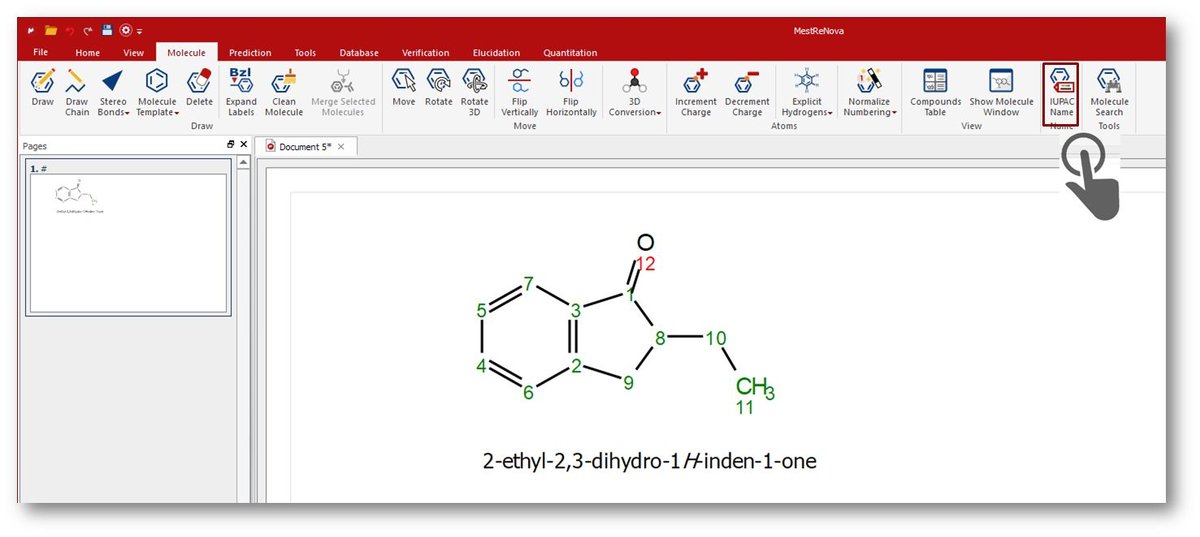
The labyrinthine world of chemical nomenclature can feel like deciphering an ancient language, especially when faced with complex organic molecules. Manually deriving an IUPAC name requires meticulous attention to a hierarchical set of rules, a task that’s both time-consuming and prone to error. Fortunately, the digital age offers powerful shortcuts. We're now exploring online IUPAC name generators that leverage advanced AI and intuitive drawing interfaces to demystify this critical scientific skill, transforming what once was a painstaking chore into a streamlined process.
No longer do you need to spend hours meticulously counting carbons, identifying functional groups, and worrying about stereochemistry; these tools are here to lend a digital hand.
At a Glance: Your Quick Guide to Online Naming Tools
- Two Main Types: Online IUPAC name generators typically fall into two categories: AI-powered tools that interpret chemical structure images, and interactive tools where you draw the molecule.
- Save Time & Boost Accuracy: Both types drastically cut down the time and effort needed for naming, while simultaneously improving the consistency and reliability of the generated names.
- Enhance Learning: These tools aren't just for professionals; they're fantastic for students to verify their own naming attempts and practice their understanding of IUPAC nomenclature rules.
- Critical Verification: Always review the generated name. While highly accurate, no AI is infallible, especially with highly complex or ambiguous structures.
- Drawing for Precision: For absolute control over stereochemistry and specific structural nuances, drawing-based tools often offer more direct input.
- Image for Speed: If you have a clear image of a known structure, AI image recognition tools can provide rapid results.
The Manual Maze vs. Digital Shortcuts: Why Online Naming Matters
Think back to your first organic chemistry class. Remember the agony of naming a complex bicyclic compound or a molecule with multiple chiral centers? The International Union of Pure and Applied Chemistry (IUPAC) provides a systematic framework, but applying those rules consistently to every new structure is a demanding cognitive exercise. For researchers, chemists, and students alike, errors in nomenclature can lead to misidentification, confusion in experimental data, and even safety hazards. This is precisely where online IUPAC name generators step in, offering a robust solution to a persistent problem.
These digital assistants streamline the process, ensuring standardized and understandable chemical names crucial for clear scientific communication and data sharing. Whether you're publishing a paper, preparing a presentation, or just tackling homework, a reliable IUPAC name generator becomes an indispensable part of your toolkit.
AI-Powered Vision: Naming From Images
Imagine snapping a picture of a chemical structure from a textbook or research paper and instantly getting its IUPAC name. This is no longer sci-fi; it's the reality with AI-powered image recognition tools. These generators leverage sophisticated machine learning algorithms trained on vast databases of chemical structures and their corresponding names, enabling them to "see" and interpret complex molecular drawings.
How BasedLabs Transforms Pictures into Names
Let's take a closer look at how a tool like the BasedLabs IUPAC Name Generator from Picture works, making the process almost effortless:
- Upload Your Image: The journey begins with a clear image of your chemical structure. You simply click an 'Upload Image' button, selecting the file from your device. The quality and clarity of the image are paramount here; a blurry or poorly drawn structure will challenge even the most advanced AI.
- Generate the IUPAC Name: With the image uploaded, a single click on 'Generate IUPAC Name' unleashes the AI. It analyzes the pixels, identifies bonds, atoms, and their connectivity, and then cross-references this structural information with its internal knowledge base to formulate the correct IUPAC name.
- Review and Verify: Once the name is generated, it’s displayed alongside your uploaded image. This is your cue to act as the final quality control. Carefully examine the generated name against the visual structure. For critical applications, always cross-reference with chemistry references or consult an expert. This verification step is non-negotiable for ensuring absolute accuracy.
The Unmistakable Benefits of Image-Based Naming
The advantages of this approach are compelling:
- Save Time and Effort: Manual derivation is notoriously time-consuming. An AI tool automates this process, freeing up valuable mental energy and hours you'd otherwise spend tracing chains and prioritizing functional groups.
- Improve Accuracy: Human error is a constant factor. AI, when properly trained, offers consistent, reliable, and accurate IUPAC names, significantly minimizing these slips.
- Enhance Collaboration: When everyone uses standardized naming conventions, scientific communication becomes clearer. These tools help ensure that data shared between researchers is uniformly understood, fostering better collaboration.
Drawing Your Way to a Name: The Interactive Approach
While AI image recognition is powerful, sometimes you need to build a molecule from scratch or precisely define stereochemical features. This is where interactive, drawing-based name generators shine. These tools provide a chemical structure drawing software interface, allowing you to construct your molecule bond by bond, atom by atom.
OrgoSolver: Building Molecules for Naming
The OrgoSolver IUPAC Namer exemplifies this interactive workflow. It puts the power of construction directly into your hands:
- Draw the Molecule's Structure: Using an on-screen editor, you construct your molecule. This includes everything from single and double bonds to specific atoms and crucially, stereochemistry – represented by wedges and dashes to denote spatial arrangement.
- Generate and Review: Once your structure is complete, you click "Get Molecule Name." The tool then processes your drawing, identifies all relevant features, and generates the IUPAC name, displaying it alongside your drawn structure. This visual pairing helps in immediate verification.
- Adjust and Refine: If the generated name isn't what you expected, or if you spot an error in your drawing (or the naming!), the flexibility to adjust connectivity or stereochemistry directly within the drawing interface is invaluable. You can make changes and re-run the naming process until the result aligns with your intent.
Precision Through Drawing: Pro Tips for Accurate Naming
Drawing-based tools offer a level of control that can lead to highly accurate names, especially when you follow these pro tips:
- Include Stereochemical Details: For molecules with chiral centers or double bond isomers, explicitly draw stereochemistry (R/S, E/Z, cis/trans using wedges/dashes for 3D representation). Without these, the name generator can only provide a general, non-stereospecific name. Understanding fundamentals of stereochemistry is key here.
- Avoid Placeholder or Wildcard Atoms: While some drawing tools allow 'X' for any halogen or 'R' for a generic alkyl group, avoid these when generating an IUPAC name. Specificity is crucial for correct nomenclature.
- For Polycyclic/Ring Systems, Ensure Clear Construction: Complex ring systems can be tricky. Make sure all rings are clearly defined, fused correctly, and that any bridging atoms are unambiguously connected. Ambiguous drawings lead to ambiguous names.
An added bonus for students and educators: OrgoSolver offers Infinite IUPAC Namer Quizzes. This feature is fantastic for practicing your naming skills and getting instant feedback, turning the often-daunting task of nomenclature into an engaging learning experience.
Unpacking the Benefits: Why These Tools Matter for Everyone
Whether you prefer the lightning speed of an AI image generator or the precise control of a drawing tool, the overarching benefits remain consistent:
- Academic Excellence: Students can verify homework, prepare for exams, and deepen their understanding of naming rules without constant reliance on a professor. Practice quizzes, like those offered by OrgoSolver, turn learning into an interactive game.
- Research Efficiency: In laboratories, researchers can quickly name novel compounds, verify structures from literature, or ensure consistent nomenclature across data sets. This accelerates data analysis and publication workflows.
- Data Integrity: Standardized IUPAC names are fundamental for databases, patents, and scientific publications. These tools help maintain high data integrity by minimizing naming inconsistencies.
- Reduced Error Rate: Human mistakes are inevitable, especially with complex rules. Automated generators provide a consistent, algorithmic application of IUPAC rules, drastically reducing the chances of error.
- Enhanced Collaboration and Communication: When all scientists speak the same chemical language, based on universally recognized IUPAC names, communication barriers diminish. This fosters better collaboration in multidisciplinary teams.
Mastering the Art: Pro Tips for Maximizing Online Naming Accuracy
Leveraging these tools effectively requires more than just knowing where to click. Here's how to get the most reliable results:
- Understand the Basics First: While these tools are fantastic, they're not a substitute for understanding the underlying IUPAC nomenclature rules. A basic grasp of functional groups, parent chains, and substituent prioritization will help you spot potential errors and verify results.
- Verify, Verify, Verify: This cannot be stressed enough. Always compare the generated name to the visual structure. Does the name accurately describe every atom, bond, and stereochemical feature? If in doubt, use a second tool or consult a textbook.
- Provide Clear Input:
- For Image-Based Tools: Use high-resolution, unambiguous images. Avoid scanned images with background noise or handwritten structures that might be difficult for the AI to interpret.
- For Drawing-Based Tools: Be meticulous with your drawing. Ensure all bonds are correctly placed, stereochemistry is precisely indicated, and rings are properly closed. Subtle drawing errors can lead to drastically different names.
- Watch Out for Stereochemistry: This is often the trickiest part for both humans and machines. Ensure all R/S, E/Z, cis/trans, and axial/equatorial designations (where applicable) are either explicitly drawn (for drawing tools) or clearly visible (for image tools). If a name lacks a stereochemical descriptor you know should be there, it's a red flag.
- Be Aware of Ambiguity: Some structures can be drawn in slightly different ways or have subtle nuances that might be interpreted differently by various algorithms. If a structure seems ambiguous, try drawing it slightly differently in a drawing tool, or find a clearer image for an AI tool.
- Consider "Preferred IUPAC Names" (PINs): IUPAC rules are vast and sometimes allow for multiple correct names, though one "Preferred IUPAC Name" (PIN) is designated. Online generators typically aim for PINs, but it's good to be aware that other technically correct (but non-preferred) names might exist.
Choosing Your Tool: Image vs. Drawing
When should you reach for an AI image generator, and when is a drawing tool the better choice?
Opt for an Image-Based Generator (e.g., BasedLabs) when:
- You have a pre-existing image: From a PDF, a screenshot, or a digital photograph.
- Speed is critical: You need a name quickly for a clearly drawn structure.
- You're unsure how to draw it: If you can recognize the structure but struggle with the mechanics of drawing it digitally.
- You're verifying a known structure: Cross-referencing a structure you found in literature.
Choose a Drawing-Based Generator (e.g., OrgoSolver) when: - You're synthesizing a new molecule: You need to name a compound that hasn't been drawn yet.
- Precision and stereochemistry are paramount: You need to explicitly control every bond, atom, and spatial arrangement.
- You're practicing or learning: Drawing the molecule yourself reinforces your understanding of its structure.
- You need to experiment: Easily adjust the structure to see how subtle changes affect the IUPAC name.
- The image input is ambiguous or unclear: When an image is poor quality, drawing it manually can be more reliable.
Both types of tools serve distinct, yet equally valuable, purposes. Often, the most effective approach is to use them in tandem, leveraging each for its strengths.
Beyond the Name: Learning and Practicing
These online generators aren't just for getting quick answers; they're powerful educational aids. For students, the immediate feedback provided by both image and drawing tools is invaluable. Imagine attempting to name a molecule, then using a drawing tool to build it and check your work. Or, perhaps you’re tackling organic chemistry practice problems from a textbook, and an image-based generator can instantly verify if your answer aligns with the correct nomenclature.
Tools that incorporate quizzes, like OrgoSolver, take this a step further, offering structured practice that reinforces learning through repetition and immediate correction. This active learning approach can significantly improve your grasp of complex naming rules.
Navigating the Naming Nuances: Common Questions & Pitfalls
Even with advanced tools, certain questions and challenges frequently arise.
Are Online IUPAC Name Generators Always 100% Accurate?
No tool is infallible. While modern generators are remarkably accurate for most common organic structures, they can sometimes struggle with:
- Highly complex systems: Extremely large, intricate, or unusual ring systems.
- Ambiguous input: Poorly drawn structures, unclear stereochemistry in images, or incorrect initial drawings.
- Very specific or obscure rules: Certain less common IUPAC rules might not be perfectly implemented in all tools.
Always treat the output as a strong suggestion that requires human verification, especially for critical applications.
What About Inorganic Compounds or Polymers?
Most online IUPAC name generators are specifically designed for organic compounds. Naming inorganic compounds, coordination complexes, or polymers follows entirely different sets of rules. While some specialized tools exist for these, a general organic IUPAC name generator won't be suitable.
Can They Handle All Stereochemistry (R/S, E/Z, etc.)?
Yes, the best tools are designed to handle stereochemistry, but only if it's explicitly provided in the input. For drawing tools, this means using wedges/dashes. For image tools, the stereochemistry must be clearly depicted in the image. If it's missing or ambiguous, the tool will either omit the stereochemical descriptors or default to a non-stereospecific name. This often requires a deeper understanding of molecular modeling tools to properly visualize.
What if I Get a Name That Looks Different But Is Still "Correct"?
IUPAC rules can sometimes lead to multiple technically correct names for a single structure, although there is usually a "Preferred IUPAC Name" (PIN). If an online generator gives a name that differs from what you expected but seems plausible, cross-check it. It might be an alternative correct name, or it might be an indication of a subtle error in your input or the tool's interpretation.
How Do I Handle Very Large Molecules or Biomacromolecules?
For extremely large molecules, like proteins, DNA, or complex polysaccharides, full IUPAC naming becomes impractical and is rarely used. Instead, researchers rely on specialized bioinformatics tools and nomenclature systems (e.g., amino acid sequences, PDB IDs) tailored to these biomacromolecules. Online IUPAC name generators are typically not designed for such scale.
The Human Element: When to Trust Your Own Judgment
Even with the most sophisticated AI and intuitive drawing interfaces, the human element remains paramount. These tools are powerful assistants, not replacements for understanding. They free you from tedious rule application, allowing you to focus on the chemistry itself.
Develop the skill to critically evaluate the output. Ask yourself: "Does this name make sense for this structure?" "Are all functional groups correctly prioritized?" "Is the stereochemistry accurately reflected?" Your chemical intuition, honed through study and practice, is the ultimate validator.
The Future of Nomenclature: AI's Evolving Role
The capabilities of online IUPAC name generators are continuously expanding. As AI models become more refined, we can expect even greater accuracy, faster processing, and the ability to handle increasingly complex and esoteric structures. Integration with other molecular modeling tools and databases will likely become more seamless, creating holistic platforms for chemical information. The aim is not to eliminate human expertise, but to augment it, making chemical communication more precise, efficient, and accessible to everyone.
Empowering Your Chemical Communications
Whether you're a seasoned chemist, a budding scientist, or an industrial professional, exploring online IUPAC name generators will undoubtedly enhance your workflow. By embracing these intelligent tools, you gain not just speed and accuracy, but also a deeper confidence in your chemical nomenclature. They empower you to communicate chemical structures clearly and unambiguously, fostering better research, improved understanding, and safer practices across the scientific community. Dive in, experiment, and let these digital assistants transform your approach to the fascinating world of chemical naming.